ABB ACS501-025-5-00P200000 Ac Vs Drive Sami Gs Vfd 480V ACS501-025-4 30
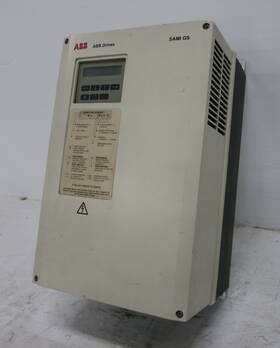
( Brand: Abb ), ( Manufacturer Part Number: ACS501-025-5-00P200000 ), ( Model: ACS501-025-5-00P2 ), ( Part Type: Ac Hp 480v Drive ), ( Country Of Origin: United States ), ( Bc Category: Vs Drives ), ( Controller Platform: Asea Brown Boveri ), ( Horsepower: 25 Hp ), ( Make: Asea ), ( Phase: 3 Phase ), ( Type/series: Vs Drive ), ( Voltage: 480 Vac )
Review ABB Hp Ac Vs Drive Sami Gs 480v Vfd 30
The **ABB ACS501-025-5-00P200000 25 HP AC Variable Speed Drive (VSD)** and the **ABB SAMI GS 480V ACS501-025-4 VFD** are high-performance, industrial-grade variable frequency drives (VFDs) designed to optimize motor control, enhance energy efficiency, and extend equipment lifespan in demanding applications. Both models belong to ABB s advanced ACS501 series, renowned for their robust construction, intelligent control algorithms, and seamless integration with modern automation systems. The **ACS501-025-5-00P200000** is a **25 horsepower (HP) drive** specifically engineered for **480V three-phase AC motors**, featuring a **PLC (Programmable Logic Controller) module (00P200000)** that enables sophisticated process automation, real-time monitoring, and customizable control logic. This configuration is ideal for applications requiring precise speed regulation, such as conveyor systems, pumps, fans, and industrial machinery where variable torque demands necessitate dynamic adjustments. The drive s **5-digit model designation** indicates its compatibility with **480V input voltage**, **25 HP motor rating**, and **5-digit PLC integration**, making it a versatile solution for mid-sized industrial applications.
The **ACS501-025-4 VFD**, while sharing the same core ACS501 platform, is optimized for **simpler yet high-efficiency motor control** without the built-in PLC module. This model retains all the fundamental strengths of the ACS501 series such as **regenerative braking, advanced vector control, and energy-saving features** while offering a more straightforward setup for applications where complex automation is not required. Both drives incorporate **ABB s advanced Sinamics technology**, delivering **superior torque response, minimal harmonic distortion, and enhanced reliability** through high-quality IGBT (Insulated Gate Bipolar Transistor) components. Their **compact yet rugged enclosures** ensure durability in harsh environments, while their **user-friendly interfaces**, including **touchscreen displays and intuitive software (e.g., ACS880 or ACS890)**, simplify configuration, diagnostics, and remote monitoring.
A key differentiator between the two is the **integrated PLC functionality** in the **ACS501-025-5-00P200000**, which allows for **direct integration with SCADA systems, PLC networks, or custom control logic**, making it suitable for **complex automation tasks** such as sequential control, feedback-based adjustments, and integration with higher-level industrial protocols (e.g., Modbus, Profibus, or Ethernet/IP). In contrast, the **ACS501-025-4** serves as a **standalone VFD**, ideal for applications where basic speed and torque control suffice, such as **HVAC systems, packaging machinery, or general-purpose motor drives**. Both drives support **regenerative energy feedback**, allowing excess energy from decelerating loads to be dissipated safely, reducing strain on the electrical system and improving overall efficiency.
Whether deployed in **manufacturing plants, water treatment facilities, or material handling systems**, these ABB ACS501 drives deliver **unmatched performance, energy savings, and operational flexibility**. Their **modular design** allows for easy expansion, while **built-in protection features** such as overload monitoring, short-circuit prevention, and environmental sensing ensure long-term reliability. With **ABB s reputation for innovation and engineering excellence**, these VFDs represent a premium investment for industries seeking **high-efficiency, low-maintenance motor control solutions** that adapt seamlessly to evolving operational demands.
### **Comparison of ABB ACS501-025-5-00P200000 (25 HP AC Motor) vs. ABB Sami GS 480V (ACS501-025-4 VFD with 30 HP Motor)**
#### **1. ABB ACS501-025-5-00P200000 (25 HP AC Motor)**
**Pros:**- **Simplicity and Cost-Effectiveness:** A standard AC motor is a straightforward, low-maintenance solution for constant-speed applications. It eliminates the need for a variable frequency drive (VFD), reducing upfront and operational costs.
- **Lower Initial Investment:** Without a VFD, the system cost is significantly lower, making it ideal for applications where speed control is not required.
- **Reliability in Fixed-Speed Applications:** If the load requires a constant speed (e.g., fans, pumps with fixed head pressure), an AC motor with a fixed-speed controller (like a soft starter or across-the-line starter) is more reliable than a VFD in such scenarios.
- **Easier Troubleshooting:** AC motors have fewer components than VFD-controlled systems, simplifying maintenance and repair.
- **Energy Efficiency at Full Load:** Modern AC motors (especially IE3 or IE4 efficiency classes) are highly efficient when operating at full load, matching or exceeding the efficiency of a VFD-driven motor in such conditions.
**Cons:**- **No Speed Control:** The motor runs at a fixed speed (determined by the supply frequency), limiting flexibility in adjusting output based on demand.
- **Higher Energy Consumption at Partial Load:** If the load requires variable speed (e.g., variable flow in pumps or fans), running the motor at full speed while throttling valves or dampers wastes energy.
- **Limited Soft Start Capability:** Without a VFD or soft starter, the motor may experience high inrush current during startup, potentially stressing the electrical system or causing voltage dips.
- **Less Suitable for Soft Start/Stop Applications:** Industries requiring frequent starts/stops (e.g., conveyors, compressors) may benefit from the torque control provided by a VFD.
---
#### **2. ABB Sami GS 480V (ACS501-025-4 VFD with 30 HP Motor)**
**Pros:**- **Variable Speed Control:** The VFD allows precise control of motor speed, enabling energy savings by matching output to load requirements (e.g., adjusting pump/fan speed to demand).
- **Energy Efficiency at Partial Load:** By reducing speed to match lower demand, the VFD can save significant energy compared to a fixed-speed AC motor with throttling devices.
- **Soft Start/Stop Capabilities:** The VFD provides controlled acceleration and deceleration, reducing mechanical stress on the motor and connected equipment while minimizing inrush current.
- **Torque Control:** Useful for applications requiring smooth torque control (e.g., conveyors, mixers, or compressors) where sudden starts/load changes could damage equipment.
- **Protection Features:** VFDs include built-in protection against overcurrent, overheating, voltage fluctuations, and other faults, improving system reliability.
- **Scalability:** The VFD can be programmed for different operating modes (e.g., constant torque, constant power), making it versatile for various applications.
- **Long-Term Cost Savings:** While the initial cost is higher, the energy savings and reduced mechanical wear can justify the investment over time, especially in high-usage applications.
**Cons:**- **Higher Upfront Cost:** The VFD and slightly larger motor (30 HP vs. 25 HP) increase the initial purchase price compared to a basic AC motor setup.
- **Complexity:** VFDs require programming, calibration, and monitoring, which may demand additional training for maintenance personnel.
- **Maintenance Requirements:** VFDs have more components (e.g., capacitors, IGBTs, cooling systems) that can fail over time, requiring periodic maintenance or replacement.
- **Potential for Harmonic Distortion:** VFDs introduce harmonics into the electrical system, which can affect other equipment unless filtered. This may require additional mitigation measures (e.g., passive filters).
- **Heat Generation:** VFDs generate heat, requiring proper ventilation or cooling solutions to prevent overheating and reduce efficiency.
- **Overkill for Fixed-Speed Applications:** If the application does not require variable speed, a VFD is unnecessary, adding complexity without benefit.
---
### **Key Differences Summary**
**Factor** **25 HP AC Motor** **VFD (30 HP Motor Sami GS)**
-------------------------- -------------------------------------------- --------------------------------------------
**Speed Control** Fixed speed (no adjustment) Variable speed (adjustable output)
**Energy Efficiency** High at full load, poor at partial load High at partial load, efficient overall
**Startup/Stop Control** Across-the-line or soft starter only Soft start/stop with torque control
**Initial Cost** Lower Higher
**Maintenance** Simple, fewer components More complex, requires monitoring
**Versatility** Limited to fixed-speed tasks Suitable for variable-speed applications
**Harmonics** None Potential harmonics (may need filtering)
---
### **Conclusion and Recommendation**
The choice between the two options depends on the **specific application requirements**: 1. **Choose the 25 HP AC Motor if:**- Your application requires **constant speed** (e.g., fixed-speed fans, pumps with no flow variation, or simple conveyors).
- You prioritize **lowest initial cost** and **simplicity** over energy savings or speed control.
- The load does not benefit from variable speed (e.g., no demand for energy savings at partial load).
- Your electrical system cannot accommodate harmonics (though this is unlikely to be an issue with a simple AC motor).
*Example Applications:* Standard centrifugal pumps with fixed head pressure, constant-speed blowers, or simple machinery where speed adjustment is unnecessary.
2. **Choose the VFD (30 HP Motor Sami GS) if:**- Your application requires **variable speed control** to match load demand (e.g., variable flow pumps, fans with adjustable airflow, or processes where torque control is critical).
- You expect **significant energy savings** by operating at partial load (e.g., HVAC systems, water treatment plants, or industrial conveyors).
- The application involves **frequent starts/stops** or **high inrush current risks**, where a soft start is beneficial.
- Long-term **operational cost savings** justify the higher upfront investment (e.g., high-usage industrial equipment).
*Example Applications:* Variable-speed pumps, adjustable-speed fans, compressors, mixers, or any process where energy efficiency and flexibility are priorities.
---
### **Final Recommendation**
- **For most industrial applications where energy efficiency and flexibility are valued**, the **VFD (Sami GS 480V with 30 HP motor)** is the better long-term choice. The ability to adjust speed, reduce energy consumption at partial load, and provide soft start/stop capabilities often outweighs the higher initial cost, especially in high-usage scenarios.
- **For simple, fixed-speed applications where cost and simplicity are paramount**, the **25 HP AC motor** is the optimal selection. Avoid overcomplicating the system unless variable speed is genuinely required.
**Additional Considerations:**- If budget is extremely tight and the AC motor meets all requirements, it may be the pragmatic choice. However, if the application could benefit from variable speed (even if not immediately obvious), the VFD s advantages may become apparent over time.
- Ensure the electrical system can handle the VFD s harmonics if chosen (though ABB s Sami GS is designed to minimize this with proper configuration).
- Consider the **lifespan and maintenance costs** of both options while the AC motor may require fewer repairs, the VFD s energy savings could offset its higher upfront cost within a few years of operation.
Details:
Input: 440-500 VAC 3 Phase 48. Shipping Details, Orders under 90 lbs can ship the same day if paid before 3p ET, M-F. We'll reply quick as possible.
This ad includes everything pictured and described above. If it is not pictured or described above, included. 0-Vain 3 Phase 0-120 Hz. Buyer may arrange their own shipping if desired.
part #: acs501025500p200000 prices
- $499.00-$950.00
specifications variablfrequen:
- brand: Abb
- mpn: Acs501-025-5-00p200000
- model: Acs501-025-5-00p2
- part type: Ac Hp 480v Drive
- country of origin: United States
- bc category: Vs Drives
- controller platform: Asea Brown Boveri
- horsepower: 25 Hp
- make: Asea
- phase: 3 Phase
- type/series: Vs Drive
- voltage: 480 Vac
seller variablfrequen:
- rating: 99.9%
- city: Chattanooga, Tennessee
- # reviews: 16547
returns variablfrequen:
- policy: Returns Accepted
- time: 30 Days
- method: Money back
- paid by: Seller
general variablfrequen:
- Drives Starters > Drives Motor Controls > Variable Frequency Drives
- condition: Used
offer variablfrequen:
- availability: In Stock
- quantity: 1
- options: Ship-to-home
- started: May 20, 2026
- sold: 0
- best offers: True
shipping variablfrequen:
- type: Calculated
- service: UPS Ground, UPS 2nd Day Air, UPS Next Day Air Saver
- cost: $83.64
- transit: 2-6 Days
- class: Standard, Expedited, One-day
- carrier: UPS
payments variablfrequen:
- wallet: Apple-pay
- other
- credit card: Discover
Abb ACS501-025-5-00P200000 Is Similar To:
- 024 34740 781 Abb Vfd Johnson Controls Brand New In Box (12.1% similar) ...(January 8th, 2019)
- 101-k25-1-u Abb Acs Motor Drive (25.9% similar) Abb acs 101-K25-1-U motor drive items were removed from surplus stock or working equipment. If you change your mind may ship the unit back at expense...(September 15th, 2017)
- 101-k75-1 Abb Acs Motor Drive (26.4% similar) If you change your mind may ship the unit back at expense. Abb acs 101-K75-1 motor drive items were removed from surplus stock or working equipment...(September 14th, 2017)
- 2072702510 Abb 7.5 Hpac Vfd (26.9% similar) For a regular pallet. 5 PAC vfd variable frequency drive 11.SUPREME supreme widgets...(October 26th, 2017)
- 3aua0000003365 Abb Amps Variable Frequency Drive 88714700026557 (32.9% similar) In original packaging and box. 2 amps software version - factory new Abb ACS550-U1-046A-2 old stock. 15HP, 11KW 208-240V 26...(March 8th, 2018)
- 3bsc980004r821 Abb Used Drive Communication Interface Board (26.5% similar) Model: 3BSC980004R821 item no. If you would like to schedule an appointment inspect item, or pick it up, please directly. Pre-purchase inspection: if you would like to arrange for a technician come in and test unit or inspect before purchase, please any time make arrangements. Include delivery ...(May 19th, 2018)
- 3bse015488r1 Abb Used Fiber Optic Drive Board Pr (30.4% similar) Please with any questions. Pre-purchase inspection: if you would like to arrange for a technician come in and test unit or inspect before purchase, please any time make arrangements. If an item is over 5,000. If you would like to schedule an appointment inspect item, or pick it up, please directly. ...(May 19th, 2018)
- 5619261e 1-2 Abb Used Drive Power Supply Board (24.4% similar) Type: NINP-61 model: 57619261E 1/2 code: 58907146J item no. Pre-purchase inspection: if you would like to arrange for a technician come in and test unit or inspect before purchase, please any time make arrangements. Save thousands and buy used from green industrial today. If an item is over 5,000. ...(May 18th, 2018)
- 6410038784348 Abb Acs55-01e-04a3-2 Inverter Drive (31.7% similar) ...(November 17th, 2017)
- 6438177223757 Abb En Manual Drive Hp Vfd New In (27.4% similar) Abb ACS355-01U-09A8-2 R700 en manual drive 240V 21A 3 hp vfd new in box...(October 18th, 2018)
- 653829094073 Abb Inverter Vfd Hvac Drive (20.5% similar) 32-CT-08-V product name: Abb inverter vfd hvac drive 380-480V bin S-2 box height 20 length width item voltage initials lg. Mfr brand name: Abb catalog no...(August 18th, 2018)